Use Cases

Physics based models capture the real physical processes taking place inside batteries. Surrogate models capture the same physics, but are orders of magnitude faster to solve. There are two distinct categories of use case.

Real time state estimation for optimised battery usage.

Given accurate estimates of physical parameters, physics based models can be used to predict internal battery states and optimise usage for safety and speed. Surrogates allow ultra-fast estimation with low computational cost. In real time, we can accurately estimate plating risk, internal temperature and temperature sensitivie parameters, and optimise fast charging.

Fast inference of physical parameters without physical teardown

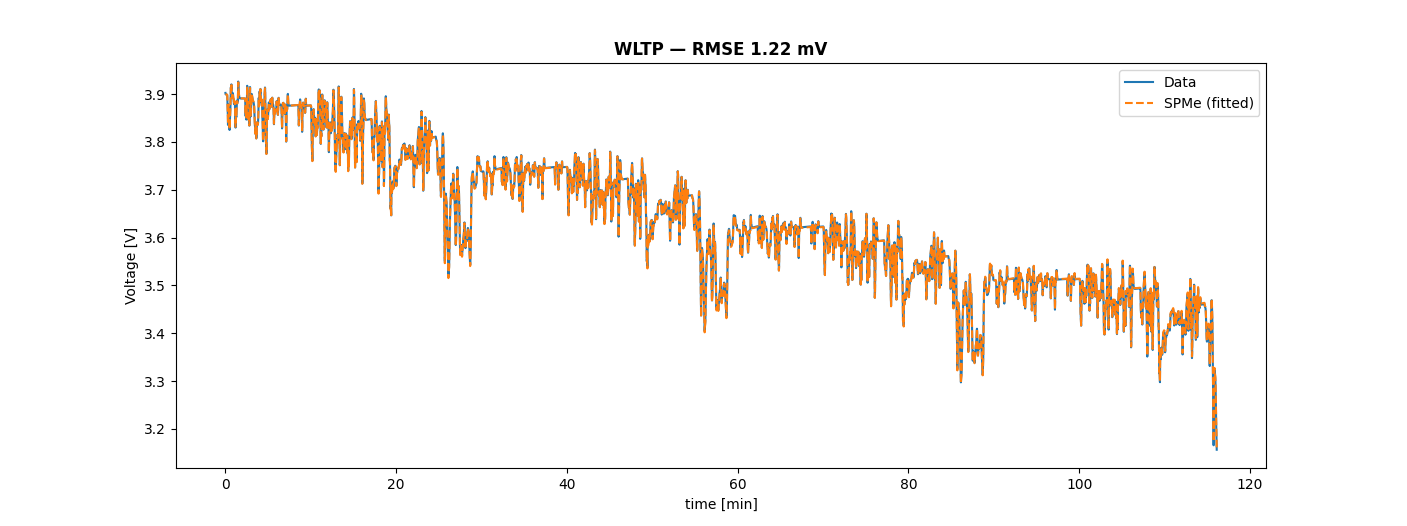
To capture the complex internal structure and state of health of a battery cell requires many physical parameters. We can estimate these via cell teardown and physical testing, but this is costly and time consuming. A fast, lightweight and inexpensive alternative is to use readily available cell sensor output (e.g. \(I,V,T\)) and to infer parameters by matching to a physics-based model. Surrogates, which measure parameter sensitivity by design, make the inference process many orders of magnitude faster than classical numerical methods.

Plating Risk Estimation

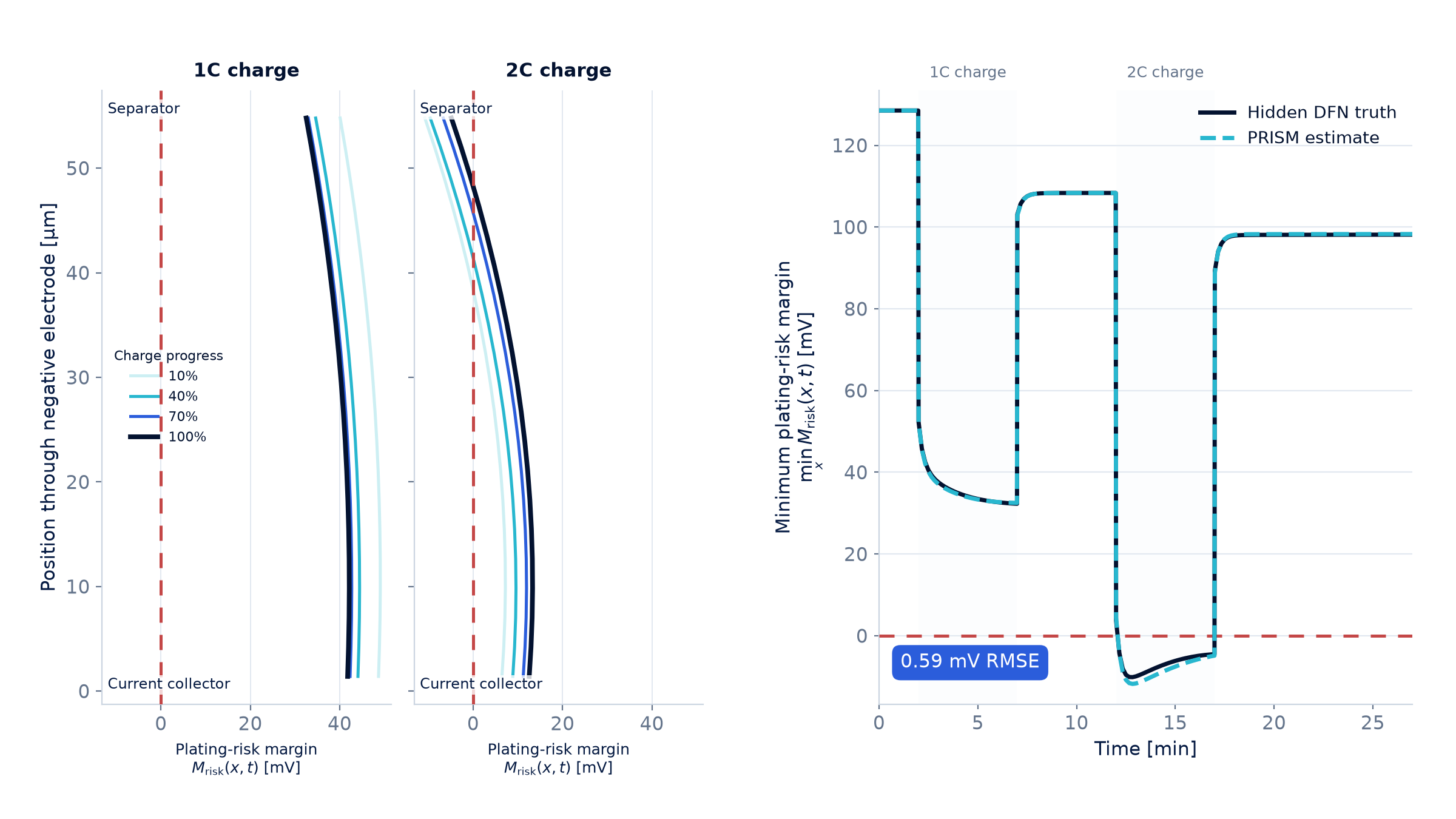
PRISM uses routinely measurable terminal signals—current and voltage, with temperature incorporated where available—to reconstruct electrochemical conditions that cannot be measured directly inside the cell. The left panels show the spatial distribution of plating risk through the negative electrode during 1C and 2C charging. We define the local electrochemical margin as

$$ M_{\mathrm{pl}}(x,t) = \phi_{\mathrm{s,n}}(x,t)-\phi_{\mathrm{e}}(x,t), $$

and the displayed risk margin as

$$ M_{\mathrm{risk}}(x,t) = M_{\mathrm{pl}}(x,t)-M_{\mathrm{crit}}, $$

where \(M_{\mathrm{crit}}\) is an onset criterion to be specified. The red dashed lines denote \(M_{\mathrm{risk}}=0\); lower values indicate greater susceptibility to lithium plating. The right panel compares PRISM's estimate of the minimum margin, \(\min_{x} M_{\mathrm{risk}}(x,t)\), with hidden high-fidelity DFN truth. In this synthetic test, only current and terminal voltage were supplied to the estimator, and PRISM tracks the hidden minimum margin with an RMSE of \(0.59\,\mathrm{mV}\). During the higher-rate charge, the onset criterion is reached first near the separator. Internal temperature and plating-risk fields were withheld during fitting. The criterion is configurable and is used here to visualise risk.

Work With Us

Working on a hard battery inference problem?

Artiphy may be able to help you if you need to:

Bring us a challenge statement. We'll help you decide whether physics-based inference can move it forward.